TL;DR
Flat concrete roofs usually leak through a failed membrane, ponding water or blocked outlets, while pitched roofs leak at cracked tiles, rusted fixings, flashings and gutters. Patch-repair a roof once or twice, but plan to re-roof or re-waterproof when leaks keep moving, the membrane is brittle across the whole roof, or water ponds for days.
Good roof repair starts with knowing what kind of roof you have, because a flat reinforced concrete (RC) roof and a pitched tile or metal roof fail in completely different ways. Singapore’s weather is hard on both: the Meteorological Service Singapore records a long-term mean of 2,113.3 mm of rain a year, falling on about 171 days (MSS), with severe afternoon thunderstorms in the October to November inter-monsoon. This guide shows where each roof type leaks, which roof membrane suits which job, and the signs that a repair is no longer enough.
Where do flat roofs and pitched roofs usually leak?
Flat roofs leak where water sits or where the membrane is broken; pitched roofs leak where water is redirected, at joints, flashings and gutters. Use this table to narrow down the likely source before calling for roof leak repair.
| Roof type | Common leak points | What you see inside |
|---|---|---|
| Flat RC roof (HDB top floor, condo, commercial) | Cracked or blistered membrane, ponding areas, upturns at parapet walls, blocked floor outlets, pipe and equipment penetrations | Ceiling stains on the top floor, damp patches near walls, spalling concrete |
| Pitched tile roof (landed homes) | Cracked or slipped tiles, ridge and hip mortar, valleys, flashing at walls and chimneys | Stains along walls and near ridges, wet roof timbers |
| Pitched metal roof (factories, carports, extensions) | Rusted screws and washers, overlap joints, corroded sheets, skylight edges | Drips along purlin lines, rust marks |
| All roofs | Gutters, downpipes and outlets overflowing in heavy rain | Water down walls, leaks only during downpours |
Why does ponding water matter on a flat roof?
Ponding matters because standing water slowly breaks down most membranes and finds every small defect. The US National Roofing Contractors Association uses a simple test that works well here too.
Quote: “The criterion for judging proper slope for drainage is that there be no ponding water on the roof 48 hours after a rain during conditions conducive to drying.” (Jason P. Wilen, NRCA director of technical services, Professional Roofing)
If puddles are still sitting on your roof two days after a storm, flat roof waterproofing alone will not last. The falls may need correcting with screed, outlets may need enlarging, or extra drainage points added before a new membrane goes down.
Which roof membrane is best for Singapore roofs?
There is no single best roof membrane; the right one depends on the roof, the traffic and the budget. These are the three systems most used for roof waterproofing Singapore buildings:
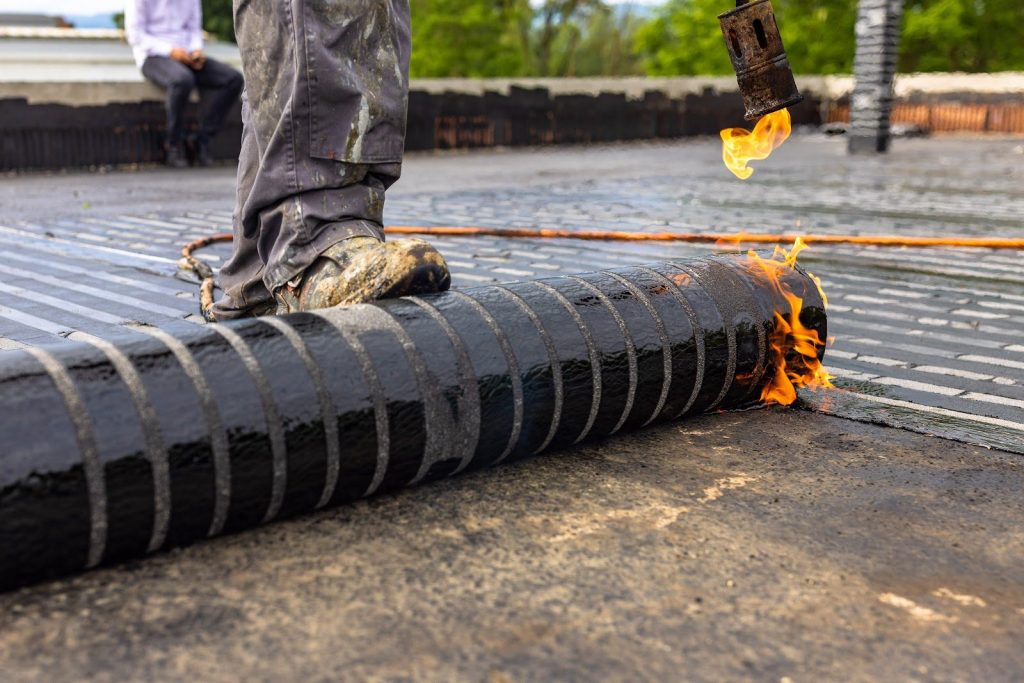
- Torch-on bituminous membrane: reinforced sheets heat-bonded to the slab with overlapping seams. It is tough and well proven on exposed RC roofs, but the seams and upturns must be detailed carefully, and torching needs safe work practices on occupied buildings.
- Liquid-applied PU or acrylic coating: rolled or sprayed into a seamless layer that wraps around pipes, plinths and awkward corners. It suits roofs crowded with equipment, but needs the correct thickness and a UV-resistant top coat to survive our sun.
- Cementitious waterproofing: a rigid or semi-flexible coating that bonds well to concrete and works best under tiles or a protective screed. On exposed roofs that move with heat, it is more prone to cracking.
How do flashings and gutters cause leaks in heavy rain?
Flashings and gutters cause leaks when a downpour delivers more water than they can carry or seal. A gutter half full of leaves, a downpipe choked at the bend, or a flashing whose sealant has cracked may stay dry for months and then overflow in one thunderstorm. Water then backs up under tiles, behind wall upturns or over the parapet and into the ceiling below, which is why many owners only notice the leak during the heaviest storms. Clear gutters and outlets before the year-end monsoon and check flashings at every wall junction.
When is roof leak repair enough, and when should you re-roof?
Targeted roof leak repair is enough when the problem is local: a few cracked tiles, one failed upturn, a torn seam or a blocked outlet, with the rest of the roof sound. Plan a full re-roof or full re-waterproofing when:
- Leaks appear in new places after each repair.
- The membrane is brittle, blistered or peeling across most of the roof.
- Ponding remains after every storm because the falls are wrong.
- Metal sheets are rusted through or tiles are failing across whole sections.
- Water has already caused water seepage into the structure or spalling in the top-floor slab.
What should a roof inspection checklist cover?
A useful roof inspection covers the surface, the drainage and the ceiling below, and it is best done before and after the monsoon. Booking it ahead of the year-end rains is one of the simplest ways to keep roof repair Singapore bills small, because defects are caught while they are still minor. Check for:
- Cracks, blisters, open seams and lifted edges in the membrane.
- Upturns and flashings at parapets, walls, plinths and pipe penetrations.
- Ponding marks, algae lines and silt on flat roofs.
- Gutters, outlets and downpipes for blockages and rust.
- Cracked, slipped or missing tiles and loose metal sheet fixings.
- Stains, peeling paint or sagging boards on top-floor ceilings, which may need ceiling repair once the roof is fixed.
How Ample Build handles roof repair in Singapore
For homeowners, MCSTs and facility managers looking for roof repair Singapore building owners can rely on, Ample Build is a BCA-registered, bizSAFE Star contractor whose in-house team traces each leak, repairs the source and restores the finish, using the membrane system that suits your roof rather than a one-size answer. When the whole roof needs renewing, our rooftop waterproofing services cover full assessments and liquid or bituminous systems, backed by our wider water leakage solutions. That keeps roof repair cost-effective: fix what is failing, and re-roof only when the evidence says so. Contact our team for a roof inspection and an itemised quote.
Frequently Asked Questions
How do I know if my roof needs repair or replacement?
Local leaks with a sound membrane can be repaired. Leaks that keep moving, a brittle membrane or constant ponding point to full re-waterproofing or re-roofing.
Who handles roof leaks in an HDB top-floor flat?
The roof is common property, so report the leak to your Town Council, which arranges the repair.
How long does flat roof waterproofing last?
It depends on the system, thickness, drainage and upkeep. Regular inspection and clear outlets extend its life, and any roof waterproofing Singapore contractor should state the expected service life and warranty in writing.
Can a roof be repaired during the rainy season?
Emergency roof leak repair can, but membranes need a dry surface, so full waterproofing is scheduled around dry spells.
Why does my roof only leak in heavy rain?
Usually overflowing gutters or outlets, or a flashing that only floods when water backs up during a downpour.