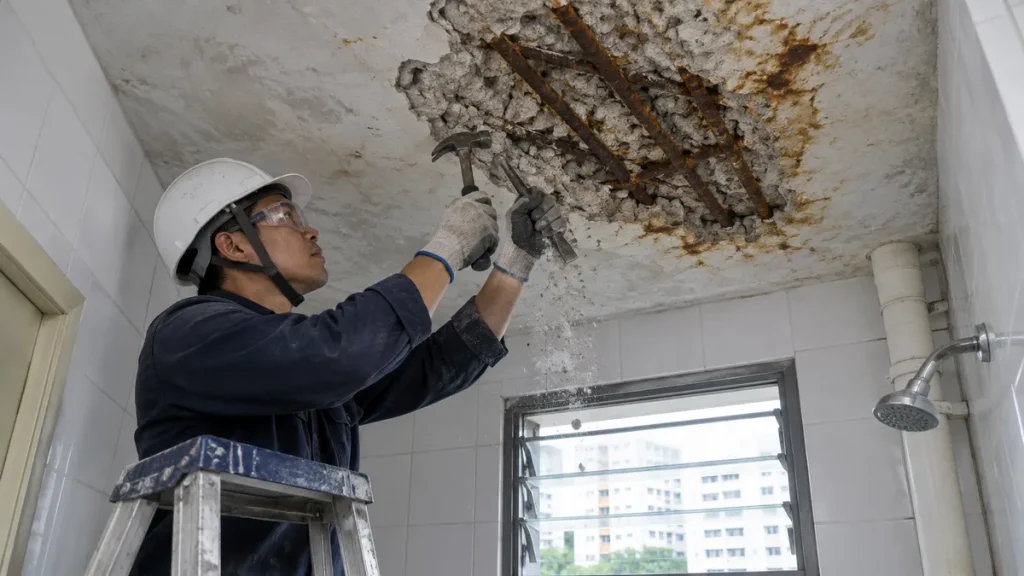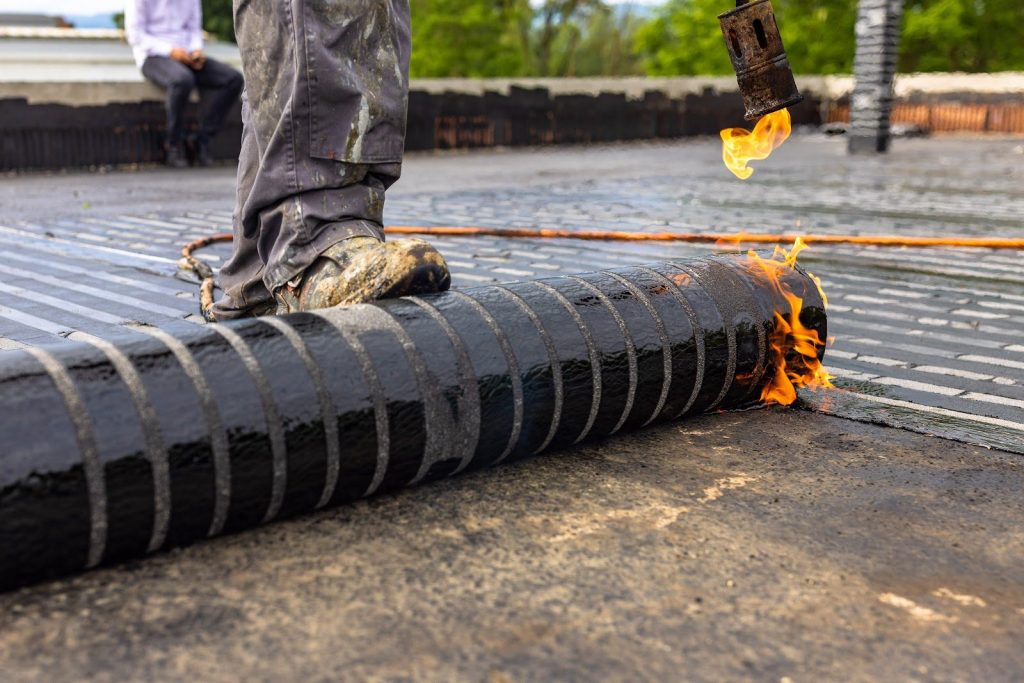
A brown ring on the toilet ceiling or a drip after the family upstairs showers: these are the calls we get most from HDB and condo owners. Bathroom waterproofing hides under the tiles, so by the time you see a stain, water has often been moving through the screed for months. This guide covers why toilets leak downward, who pays, how a ponding test works, and how our team chooses between a quick water leakage repair and hacking the floor.
Key Takeaways
- Most toilets leak to the unit below because the waterproofing membrane and screed under the tiles have worn out.
- The leak often starts around the floor trap and pipe openings.
- Confirm the source with tests first, then choose between a localised fix and hacking the floor for full re-waterproofing.
- Prove the new membrane with a ponding test of at least 24 hours before tiling.
Why does a toilet leak into the unit below?
Toilets leak downward when the waterproofing membrane and screed beneath the tiles break down. HDB says these leaks usually come from wear and tear of the membrane and screed, mostly in toilets and older buildings (HDB Home Care Guide: Ceiling Leaks).
The weak points we find most are the floor trap joint, pipe openings, cracked grout that lets water soak the screed, and wall corners where the membrane was never turned up. A choked trap or leaking concealed pipe can cause the same stain, so we test before we hack.
How do you confirm where the leak is coming from?
Test each possible path separately: floor, floor trap, pipes and shower area. A good water seepage contractor checks them one at a time instead of guessing from the stain.
| What you see below | Likely source above | How we check |
|---|---|---|
| Stain directly under the floor trap | Gap between trap and slab, short or cracked trap collar | Water poured only at the trap, ceiling watched below |
| Damp patch under the shower area | Worn membrane, cracked grout, saturated screed | Ponding test with the floor trap plugged |
| Drip that continues when the toilet above is unused | Leaking concealed water pipe | Pressure test of the supply pipes |
| Stain along a wall edge | Membrane not turned up, wall tile joints, pipe penetrations | Moisture readings along the wall base and around pipes |
| Leak only in heavy rain | Roof or external wall, not the toilet | Report to the Town Council or MCST |
Testing needs access to both units, so agree a timeslot with your neighbour early, and plan the ceiling leak repair Singapore owners need below only after the source is sealed. Our ceiling repair guide covers that finishing stage.
Who pays for an inter-floor leak in HDB flats and condos?
In HDB flats, the upper and lower flat owners share the cost of repairing the slab between them. HDB says owners are responsible for the upkeep of their flats and, where slab repair is needed, you and your upper-floor neighbour “will have to arrange for the repair work and split the costs involved”.
Roof and external wall leaks go to the Town Council, and void deck leaks are split between the Town Council and the owner. HDB also runs a Goodwill Repair Assistance scheme for ceiling leaks; in Parliament in April 2025, Senior Minister of State Sim Ann said HDB covers 50% of the repair cost under the scheme, with the rest split between the two owners, and that HDB assisted with 859 complex water seepage cases in 2024 (Stomp report). Check your eligibility with HDB before work starts.
In condos, the Building Maintenance and Strata Management Act presumes an inter-floor leak comes from the unit above unless that owner proves otherwise (SingSaver summary of BMSMA s101).
What is a ponding test and how long should it run?
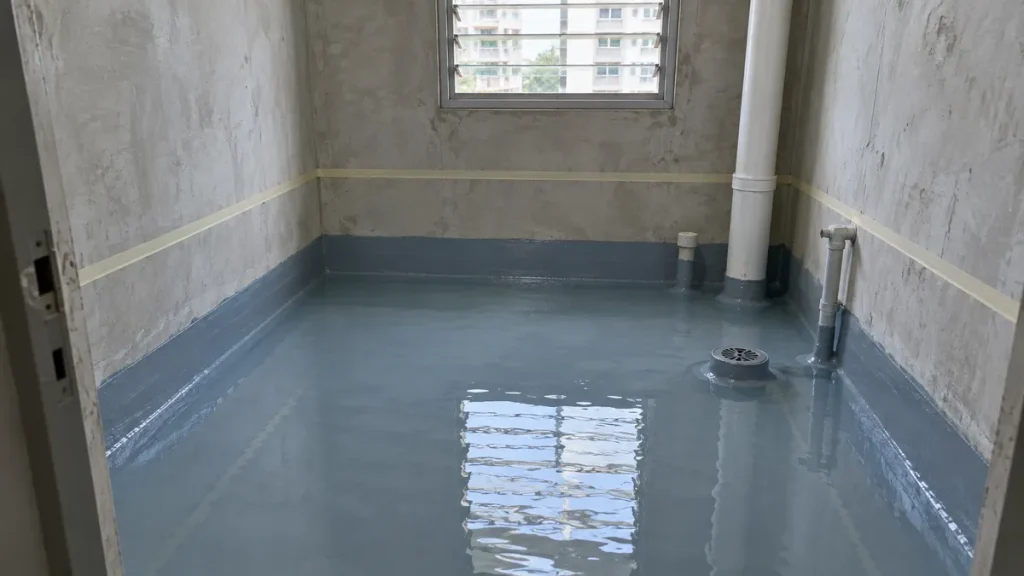
A ponding test, also called a flood test, holds water over the waterproofed floor for a set time to prove the membrane before screed and tiles go on. ARDEX’s technical bulletin calls for water 25 mm to 100 mm deep for a minimum of 24 hours, after the membrane has fully cured (ARDEX TB266).
On our jobs, we plug the trap, mark the water level and check the ceiling below during and after the test; if the level drops or a damp spot appears, we repair and retest. Ask any waterproofing contractor you shortlist whether the test is in the quote and whether you can see the result before tiling.
“It’s critical to take the time to do an accurate installation, and that includes a complete flood test with full documentation.” – Dan Welch, Welch Tile & Marble Company, in TEC’s flood test guide
When should you hack the floor, and when is a localised repair enough?
Hack the floor when the membrane has failed across the bathroom; a localised repair suits a leak confined to one point, such as the floor trap. HDB recommends re-screeding as Method 1, which means removing tiles and screed, laying a new waterproof membrane and at least 20 mm of new waterproof screed, then re-tiling.
HDB also lists localised floor trap repair, PU injection, flood infusion, the Overlaying Waterproofing Membrane System and nanotechnology coatings. Our article on PU grouting vs waterproofing for ceiling leaks compares injection. We recommend hacking when:
- The stain below covers most of the bathroom footprint, not just one spot.
- Tiles sound hollow or grout stays dark long after the floor is dry.
- Earlier injection or coating repairs have not held.
- You are renovating the bathroom anyway.
What rules apply when re-waterproofing a bathroom?
In HDB flats, replacing bathroom floor finishes needs a permit and is only allowed after the first 3 years from the block’s completion. HDB’s renovation rules also require pre-packed waterproofing screed and a waterproofing membrane, a membrane upturn of at least 150 mm against walls, kerbs and pipes, uPVC floor trap grating with a long collar, and total finishes plus screed of no more than 50 mm (HDB Building Works guidelines).
The wider reference standard is SS 637:2018, the Singapore code of practice for waterproofing of reinforced concrete buildings, which replaced CP 82; MCST by-laws may add working-hour rules.
How Ample Build handles bathroom waterproofing
As a BCA-registered, bizSAFE Star waterproofing contractor, our in-house team tests before it hacks, so you pay only for what the leak needs. Bathroom waterproofing is part of our wet works, alongside plastering and tiling, and we pair it with water leakage solutions such as pipe pressure testing and pressure grouting when the source is not the floor. You can see similar work in our Belmont Road re-tiling and re-waterproofing project. If you need a water seepage contractor who can trace the leak, fix the waterproofing above and handle the ceiling leak repair Singapore owners need below, contact our team for an inspection and an itemised quote.
Frequently Asked Questions
How long does bathroom waterproofing take?
It depends on the method and curing times. A full re-screed includes hacking, membrane curing, a ponding test of at least 24 hours, screeding and tiling, so expect several days.
Can waterproofing be done without hacking the tiles?
Sometimes. PU injection, overlay membranes and coatings can work for localised or early leaks, but widespread membrane failure usually needs hacking and re-screeding.
Who pays if the upstairs renovation caused the leak?
Cost sharing generally applies to wear and tear. If the leak was caused by the upper owner’s renovation work, that owner may be liable, so keep photos and contractor reports.
Is water leakage repair covered for new HDB flats?
New flats have a 5-year warranty for ceiling leaks, which ends if floor tiles are changed or the waterproofing system is tampered with.
Do I need a permit to redo bathroom waterproofing in an HDB flat?
Yes. Replacing bathroom floor finishes needs an HDB renovation permit and must follow HDB’s waterproofing requirements.